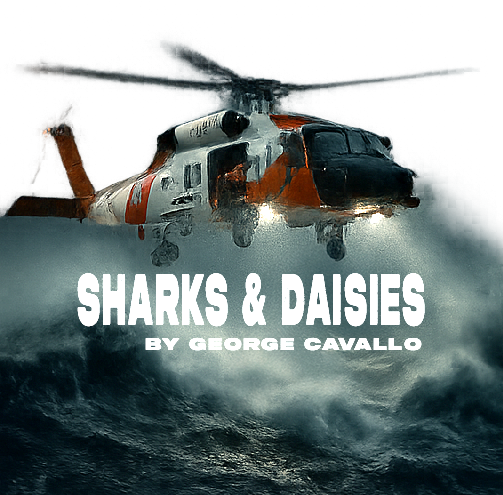
Sharks & Daisies
Tales of a Coast Guard Rescue Swimmer
REVISED & EXPANDED EDITION
Written by: George Cavallo #122
Free Sample Chapter 5
- A high-stakes medevac, a burning boat,
and the birth of a rescue swimmer.
- When the rotor spins, there’s no turning back.
Copyright © 2025
Chapter 5
Pelicans and Alligators
Rotor thunder filled the cabin, a metal heartbeat you could feel in your teeth. Straps bit into my shoulders as the helicopter arced up, the world tilting until sky and sound fused into one bright roar.
At the top of the loop everything let go—gravity, noise, even breath. A pen slipped from the crewman’s fingers and drifted between us like a slow comet. For five weightless seconds we were ghosts in a spinning machine. Then the Huey groaned, warning lights winked alive, and the cockpit howled its protest. We weren’t playing a safe game, and every alarm said so.
I was a young and naïve seaman then, lucky enough to grab a seat with a group of Army reservists who had landed at my small boat station on Ocracoke Island. They offered a ride to a few Coasties, and I jumped. Looking back, it probably didn’t help that the pilots had been out late drinking the night before. At the time, I was just hungry for the adventure—my first helicopter flight—without a clue how often the job would flirt with peril.
Rescue Swimmer School pool water was barely dry on my skin when I hit Elizabeth City Air Station, North Carolina—itching to prove myself. Then out of the mist it came, hulking and alive, like some mythic beast. The Coast Guard HH-3F Pelican shouldered through rain and rotor wash, its blades beating the sky like war drums. Steel, rivets, and raw muscle. One of the most powerful machines in our hangar—and I couldn’t wait to get my hands on it.
With its massive rotors beating the air like a giant bird, the Pelican loomed over the field like a force of nature. She was built like a flying boat: marine running lights, a radar “dolphin nose,” even an anchor in the crew cabin. A former Navy amphibian aircraft converted for long-range air-sea SAR, she was still a helicopter made of more than two thousand parts trying to shake each other loose in flight.
On graduation day we shivered on the staging line, pretending to joke while we waited for our first ride. The Pelican would take most of us up—and, as part of the ceremony, we’d jump for our first swimmer deployment. Excited and a little keyed up, we watched her descend through the mist.
As the rotors thumped closer, I could feel the machine tug at my body. Thrill met reality. Petty Officer Joe Rodriguez—Joe-Rod—huddled us tight, then led the way aboard. The sky was overcast; the air carried the sour, brackish bite of the Pasquotank River we all knew too well.
The noise spiked as we loaded. Flight mechanic David Barber appeared in the doorway in an orange flight suit and an orange-and-white helmet plastered with stickers, dark visor down against the rotor blast. Those twenty-five-foot black blades scythed the air at well over 120 miles an hour, just nine feet off the deck—and still we followed Joe-Rod into the belly of the aircraft without hesitation.
We buckled into red troop seats along the cabin walls. Two pilots up front were separated from us by “the broom closet,” where control rods ran like tendons. The aft ramp was hauled shut. Overhead, exposed lines bled honesty—hydraulic and oil we could see. The H-3 motto went, If she ain’t leaking, she ain’t flying. Amphibious or not, water landings never felt natural.
On my first water landing some months later, after I’d qualified, I asked myself: Are we a helicopter or a boat? The ocean patch below us churned like a washing machine, but the pilots called it within limits. The moment we touched, the airframe rocked hard side to side.
“Abort! Abort! Abort!” the copilot barked, and the beast clawed skyward again.
We powered up; the rotor roar thickened. Thrust pinned me to the seat while salt mist smeared the windows. A bang cracked the cabin. One engine spooled down. We fell like a stone, and I braced for impact.
We hit nose-low with a heavy thud. Metal complained. Water surged into the cabin. We weren’t flying anymore—we were floating and thinking about sinking. The level rose to my knees. My fingers trembled on the buckle before training snapped back into place.
I popped the escape window, crawled out, and stepped onto the sponson as the aircraft steadied. That’s when I realized I’d made a rookie mistake: I was still plugged into the intercom. I could hear the pilots and the flight mech sitting calmly inside.
“Pilot to crew: compressor stall. Everyone all right?”
“Flight mech to pilot: the swimmer egressed his window.”
“You’re kidding.”
“Nope.”
“Pilot to swimmer: where are you?”
“Swimmer to pilot: uh…sir, outside on the sponson.”
Laughter boomed in my headset. “Swimmer, please join us back in the aircraft.”
I climbed in, reset the window, and took my medicine later from the aviation master chief. Lesson learned. I still logged a lot of hours in the HH-3 during my Elizabeth City tour.
One dark, rain-torn night I strapped into another H-3 as Hurricane Hugo marched up the Southeast. Our crew launched into the wind and sheets of water, headed for Charleston. From the air the damage was a map of ruin—roofs torn clean, timbers snapped, neighborhoods stripped to bone. We refueled at a small field and sacked out on makeshift cots; I slept under the wing of a Cessna that had speared a hangar wall.
At first light we briefed. Tasking: haul water for survivors to a Red Cross staging area, await additional assignments from Charleston’s command post, keep our heads on a swivel for other rescue aircraft. The pilots and mech pulled on green fire-resistant flight suits rated to stand heat we hoped we’d never meet. Despite the warmth, we packed orange water-survival suits for any over-water leg.
Engines spooled, blades blurred, and we rolled. From altitude the city looked combed flat in places—thousands of trees laid down as if a giant had pressed a hand across them. We loaded pallets of bottled water and pushed off along the coast.
The shoreline was chaos: dumpsters, cars, trucks, and boats scattered like dice. Waterfront condos were peeled open, living rooms exposed to the sun. The radio crackled—new tasking to search marshes and the Intracoastal for survivors. Locals had tried everything: running south, burying hulls, tying boats inland. Hugo didn’t care.
Inland, the mess deepened—boats stacked in marinas, cars tossed like toys, a refrigerator in the middle of a road. Surge over twelve feet had dragged hulls miles from water. We checked every boat we overflew, engines drumming, eyes hunting for motion. Luckily, empty.
LT Dan Burbank’s voice came cool on the intercom—steady, focused. He vectored us along a search pattern over bright, wind-flattened marsh. Then we saw it: a forty-foot sailboat on its beam, stranded deep in grass.
I was already in a green flight suit, black boots, green inflatable vest. The flight mech hooked me to the hoist and I stepped into space, legs crossed, hands tight on the vest webbing. The downwash from those sixty-two-foot blades shoved the world flat. The marsh rippled like fur.
I kept my eyes on the hull, picking a landing spot—but the ground looked…alive. Rotor wash can play tricks. I glanced up—bold black USCG on the underbelly sliding above, the mech’s helmet just outside the door, thick leather glove guiding cable. I looked down again and felt the jolt.
The “grass” moved because tails were moving.
Alligators. A lot of them.
I unhooked and the cable snapped skyward. Water closed over my boots; I was knee-deep in grass and teeth. I signaled hard for a pickup, but the crew didn’t catch my panic. I spotted a blotch of higher ground and sprinted—knees high, stumbling, stepping on things I didn’t want to name—adrenaline burning a path to the mound.
A white-bearded man in a green cap popped up at the bow hatch, shouting and waving. The gators eased closer, floating higher than the grass. The boat was safety. I ran again—high knees, eyes wide—slammed a forearm on the rail and flopped aboard as the helicopter circled out.
Hemingway’s cousin stared down at me. “Are you crazy?” he asked.
I lay there gulping air, the reality catching up: I’d dodged the jaws, but I wasn’t out of trouble.
Rescue Swimmer School teaches you about sharks, parachutes, debris fields—never alligators. The skipper told his story: he’d moored up a creek and tied to a dozen trees. Hugo snapped the lines one by one. He rode it out, then blacked out from exhaustion.
I offered him a ride to Charleston; he waved it off. “Call my wife. Tell her I’m alive and where I am.”
I radioed for pickup. The pilot didn’t love hovering near a mast, but I explained the company I was keeping. Alligators can take a shark if they have to. Their eyesight is poor, but in their element you respect the bite radius. The pilots agreed to a high hover—no ground effect, less lift, more risk—and made it work.
Minutes later I was on the hook, up and away, headed for more sorties. We worked South Carolina for a week—rescues, water, food—until the tempo eased. Back at the air station I told the crew the gator story. They laughed, shook their heads, and nicknamed me “Alligator Dundee Swimmer.” Someone dropped a dried gator head on my desk. I kept it for years—a reminder that not every hazard swims in salt water.
About the Author
ASMC George Cavallo (#122)
George Cavallo dedicated sixteen years to Coast Guard aviation as a rescue swimmer before retiring as a warrant officer and marine inspector after two decades of service.
As a U.S. Coast Guard rescue swimmer, he spent twenty years leaping into freezing seas and hurricane winds, where every mission carried the same purpose: bring someone home alive. He was never the fastest or the strongest, but he was stubborn, gritty, and relentless—the kind of swimmer who refused to quit when others might.
That same grit carried him through triumphs, disasters, and ten difficult years that tested everything he was, where art and storytelling became his lifeline.
He earned the Coast Guard Air Medal for heroism in aerial flight on January 5, 2000, after braving twenty-foot seas and near-zero visibility to rescue three fishermen from the capsized F/V Raduga off Cape Chiniak, Alaska. His courage that day—and countless untold missions like it—would later inspire his writing.
His first book, Sharks and Daisies: Tales of a Coast Guard Rescue Swimmer, dives into the raw chaos, dark humor, and humanity of life at sea. His follow-up, Top Fin: Courage and Chaos, co-authored with Master Chief Darell Gelakoska, tells the story of the men who built and defined the Coast Guard rescue swimmer legacy.
Today, he is an artist, photographer, and storyteller. His work appears in galleries and in the Coast Guard Art Program, reflecting the same tension between grit and beauty that defined his years in uniform.
He lives in Tucson, Arizona, with his wife, Michelle—still guided by the belief that the measure of a person isn’t how many times they fall, but how many times they rise, ready to dive back in.
Get the Full Book on Amazon:
📘 Sharks & Daisies — also available on Audible
From adrenaline-pumping rescues to the scars they leave behind, each chapter pulls you closer to the edge of what it means to risk everything… and go back for more.
From adrenaline-pumping rescues to the scars they leave behind, each chapter pulls you closer to the edge of what it means to risk everything… and go back for more.
📗 Top Fin: Courage and Chaos
Co-authored with Master Chief Darell Gelakoska, this powerful follow-up dives even deeper into the legends, lessons, and legacy of the Coast Guar hey tangerine willd rescue swimmer brotherhood.
Co-authored with Master Chief Darell Gelakoska, this powerful follow-up dives even deeper into the legends, lessons, and legacy of the Coast Guar hey tangerine willd rescue swimmer brotherhood.